
Carbon Rights Trading
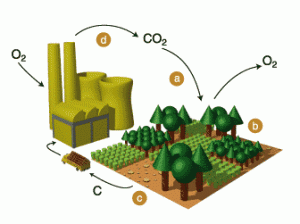 In response to the threat of climate change, the UN passed the Kyoto Protocol in 1997, which was gradually ratified by 156 countries, and later infamously rejected by the world’s biggest polluters. The Protocol sets the target of reducing emissions by an average of 5.2 percent below 1990 greenhouse gas levels by the year 2012.
About Carbon rights / allowances
Under the Kyoto Protocol the “polluters” are countries that have agreed to targets for reducing their greenhouse gas emissions below their country-specific target in a pre-defined time frame. These countries are the largest polluters, the “developed” countries. The polluters are then given a number of “emissions permits”. The volume is equivalent to their 1990 levels of emissions plus/minus their reduction commitment. These permits are measured in units of carbon dioxide, one of the main greenhouse gases. One tone of carbon dioxide equals one permit. The credits are licenses to pollute up to the limits set by the commitment to reach the average reduction of 5.2 percent agreed in Kyoto. The countries then allocate the permits to the most polluting industries, most commonly for free. In this system the polluter is rewarded.
Trading Mechanism
Credit-earning projects that take place in a country with no reduction target (mostly in the “developing” world) come under the controversial rubric of the “Clean Development Mechanism” (CDM). Projects which take place in countries with reduction targets come under Joint Implementation (JI).
CDM and JI projects can take a variety of forms: carbon sequestration in mono-culture tree plantations; renewable energy projects such as solar or wind projects; improvements to existing energy generation; methane capture from landfills; basic improvements to polluting factories and so on.
Eucalyptus Plantations are considered very efficient in such projects, as they can absorb large amounts of carbon during their life cycle and so, such projects can be validated by CDM, and get significant earnings.
EHL has already proceeded to preliminary actions for a pre-evaluation of the forthcoming project in Zambia, regarding a plantation of 5.000 hectares.